
 Last Friday saw the official public launch of the Commemorating Augustus project, in the form of a half-day colloquium in the department of Classics at Leeds. The aim of the event was to bring together some of the confirmed speakers from the main conference next year, some of those considering proposing a paper for it, and anyone else interested in the project. That way, we could all see how our own work fits into the project as a whole, and get started on the collective conversations about Augustus and his receptions which will culminate in the conference itself. I’m glad to say that the event worked really well on both fronts, attracting plenty of attendees (especially given that it is exam season!) and sparking off some really interesting discussions which we will certainly want to continue at the conference next year.
Our afternoon started in the first century  BC, with two papers centring around the event which next year’s bimillennium will commemorate: Augustus’ death. Mary Harlow (Leicester) began the event by presenting a paper which she had co-authored with Ray Laurence (Kent) on ‘Augustus and Old Age‘. Mary and Ray have been working together on ageing and life courses in the Roman world for over a decade now, putting them in an excellent position to explore the ways in which Augustus presented himself as a continuing centre of political authority even as he became old and decrepit.
Famously, of course, Augustus chose not to acknowledge his physical ageing in his portraits, so Mary started off by sharing a very clever photo-manipulation of the Prima Porta statue with its features artificially aged – a great way to shake us out of seeing Augustus as perpetually youthful and get us to think instead about him as an old man! She went on to talk us through Roman conceptual models for the various stages of life, and the behavioural expectations which go with them, before focusing in on perceptions of the elderly as expressed in art and literature.
Augustus himself, as Mary showed, conforms to and confirms some parts of the typical trajectory for the ageing Roman elite male – for example in his role as a grandfather and his relief at passing his ‘grand climacteric’ (the 63rd year of life). But unlike other elderly men there was no possibility of him retiring from public life. Instead, he found ways of managing his advancing age which I felt had considerable resonances with the tactics now being deployed by the Queen – foregrounding younger family members and limiting his appearances in the senate, but still exerting an active and forceful control over public affairs.
 Valerie Hope (Open University) then carried us forward to the aftermath of Augustus’ death in her paper, ‘Grieving for Augustus: emotion and control in Roman imperial mourning ritual.’ Valerie has published extensively on Roman funerary monuments and commemorative practices, and is currently working in particular on traditions of Roman mourning. Taking George Osborne’s recent tears at the funeral of Margaret Thatcher as a starting-point, she asked us to consider social expectations regarding appropriate expression of mourning behaviour, both ancient and modern. In the ancient world, of course, these expectations were heavily gendered, with men permitted to show moderate, but not excessive, grief, while women were expected to be far more openly expressive, especially for close family members. Drawing on the literary models of ‘good’ and ‘bad’ emperors, Valerie was able to outline the expectations of a ‘good’ male mourner through the example of Augustus himself, who supposedly bore his losses with bravery and resignation, though not without any emotional response at all.
Moving to Augustus’ funeral, Valerie observed that although it was visually splendid, surviving descriptions report very little in the way of noise or clamour. Only Tiberius groaned out loud in the senate (Suet, Tib. 23) – a response which Valerie felt has been unfairly labelled as insincere. For other senators the appropriate response was perhaps muddied by the fact that Augustus’ death also meant his deification and Tiberius’ accession to power. Meanwhile, the ordinary people’s desire to mourn their Pater Patriae was left rather unfulfilled in the old-fashioned funeral proceedings overseen by Tiberius and Livia.
We next paused for coffee, before shifting our focus to Augustus’ posthumous legacy. This will be the major focus of next year’s conference, and was represented at the colloquium by two papers on receptions of Augustus in the mid-twentieth century. The first was my own, and dealt with the commemorations held for the bimillennium of Augustus’ birth on September 23rd 1938. Under the title ‘Peace for our time? Commemorating Augustus in 1938,’ I first set out the range of events held worldwide at this time. The commemorations held in fascist Italy have been thoroughly studied, but using newspaper archives, bibliographical databases and contemporary periodicals I have uncovered at least forty more events held across western Europe, north America and Australasia which are currently largely unrecognised. These are important examples of Augustan receptions in their own right, and can also help us to place the Italian events in a more meaningful context.
Working through the non-Italian commemorations, I showed how most expressed a very idealised view of Augustus as a bringer of peace and a cultural unifier. This would soon be swept away by Syme’s delineation of his ruthless rise to power in The Roman Revolution. But in a world recovering from one World War and hoping to prevent a second it is not surprising to find that people looked to Augustus as an icon of peace and harmony. Meanwhile, one German expatriate journalist used the occasion of the bimillennium to compare Augustus with Hitler, casting the tyranny of the former as a dire warning against the latter. Arguably, this is just as distorted a perspective on Augustus as the more common tendency to view him an icon of peace and stability – but grounds for both can be found in the ancient sources. I closed by suggesting that Augustus’ real attraction in 1938 was his capacity to serve almost any contemporary political agenda via the language of a shared Classical heritage.
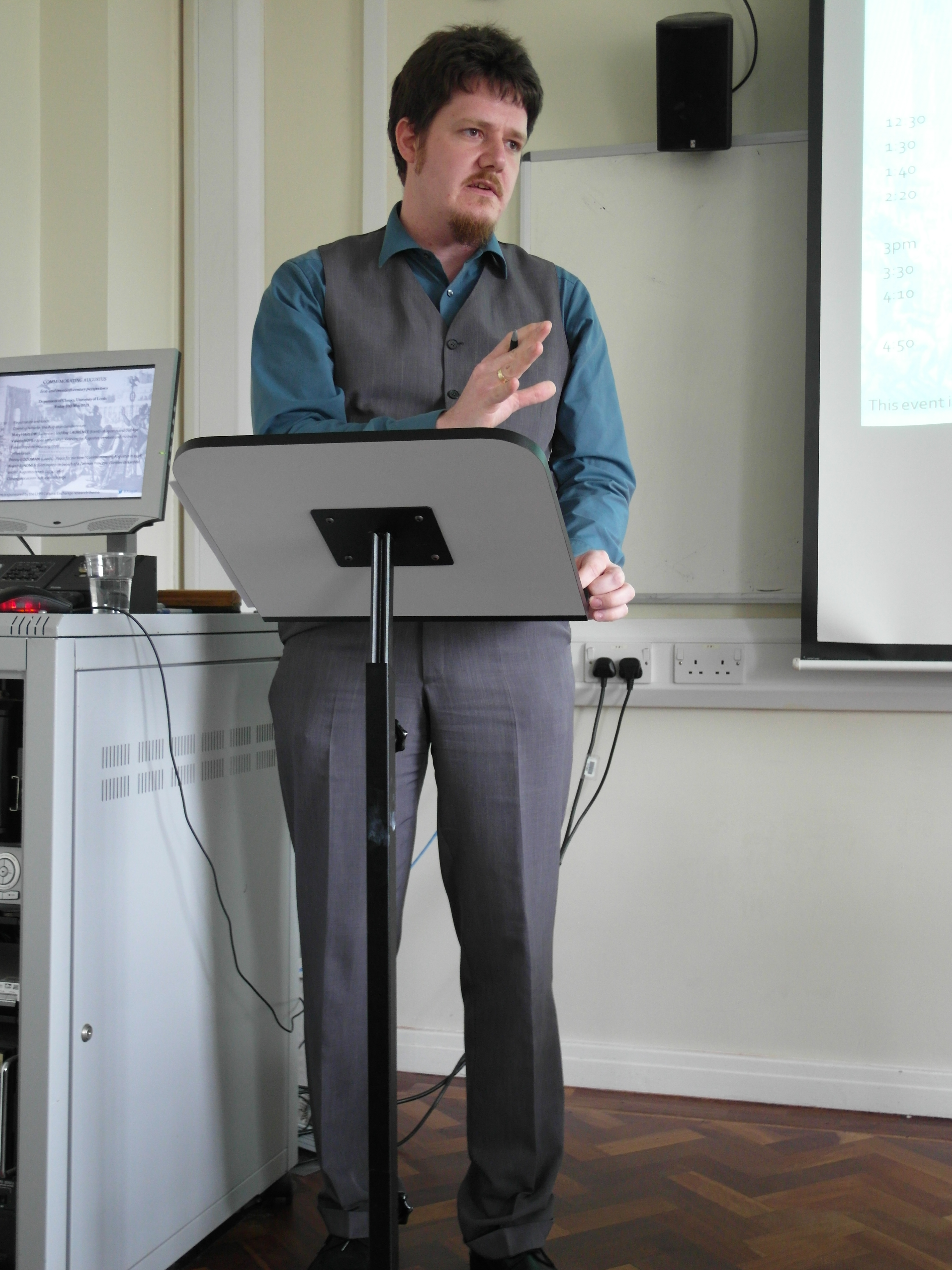 Finally, Martin Lindner (Göttingen) focused directly on mid-twentieth-century Germany with a close study of interpretations and re-interpretations of Augustus across three re-writes of a single novel. Martin has published the only systematic book-length study of Roman emperors in film, as well as an impressive series of articles exploring issues of national identity in receptions of the ancient world. His paper applied this interest to Augustus under the title ‘In search of a German Princeps: Günther Birkenfeld and his Augustus novels (1934-1962)‘.
Birkenfeld is not well known today, even within Germany, so Martin first outlined his background as a Classical historian and the beginnings of his career as a writer. It was his Augustus novel, though, which really brought him fame. Published initially in 1934, but significantly rewritten and re-released under different titles in both 1943 and 1962, Martin pointed out how the various editions coincide with and reflect three watershed moments in German history: the establishment of the Third Reich, the Second World War and the construction of the Berlin Wall.
Birkenfeld’s Augustus was never simply a cipher for Hitler, even in 1934. Instead, as Martin showed, Birkenfeld’s prevailing interest lay in the Augustan principate as the ideal context for the birth of Christianity. Nonetheless, his characterisation of Augustus as youthful, ambitious and purposeful in the first edition matched contemporary German ideals of leadership, while the later versions reflect the crumbling of that ideal. The 1943 edition made much greater play of Augustus’ self-doubts, while the 1962 version directly acknowledged his responsibility for cruel actions, even while maintaining that the ends justified the means. Yet a posthumous reprint of 1984 returned to the text of the original edition, complete with language and concepts which were no longer considered appropriate in the post-war era. As Martin explained, the novel itself had now become a historical artefact, bringing a new generation of Germans face to face with their own history through the story of Augustus.
All four papers prompted interesting and stimulating discussions, and I will certainly find some of the questions raised after my own paper helpful in developing my ideas and arguments further. But we also closed the afternoon with a more general discussion designed to articulate the shared approaches and concepts which lay behind our papers. In light of the funding awarded to the colloquium by the Leeds Humanities Research Institute Cultural Exchange research theme, I put the over-arching questions posed by the theme to the room, and invited discussion in particular around the one addressed most directly by our papers: ‘How do we conceive of and talk about the relationship between past and present?’
This turned out to be a very fruitful question to ask about the study of Augustus. He is comparatively well served by the historical sources, yet as we agreed, much of what we think we know about him proves insubstantial or ambiguous when examined closely. This can mean that although it is tempting to imagine that we can enter into a straightforward dialogue with him, in reality that conversation is one-sided. As a result, we are free to fashion Augustus in our own image – and yet as Ulrike Roth put it, even as we do so, in some ways he is still controlling us. He cultivated the very ambiguity which makes him a tabula rasa today by striving to maximise his appeal in his own lifetime, leaving us no better able to see him as a coherent human being than his contemporaries. Meanwhile, the study of his receptions highlights the ambiguity of the historical Augustus by demonstrating his capacity to generate so many very different responses. In terms of the LHRI Cultural Exchange questions, thinking about Augustus reminds us that while any relationship between the past and the present must inherently serve the interests of the present, its parameters are still defined by the interests of the past – even, and perhaps especially, when we think that they are not.

 Commemorating Augustus